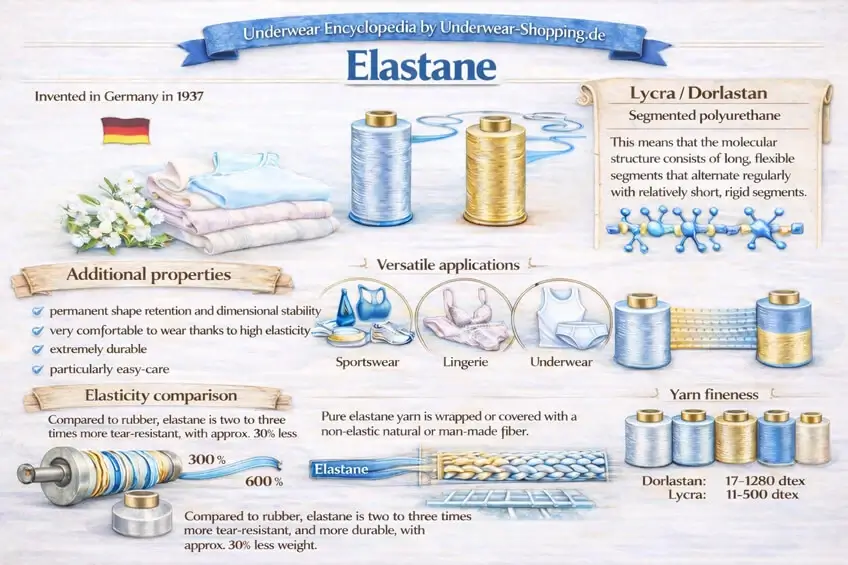
Elastane was invented in Germany in 1937 and has an exceptional elasticity for which there is no example in nature. The fibre can be stretched to four to seven times its length and returns to its original shape once released. It therefore has the highest stretch elasticity of all textile raw materials – compared with rubber it is far more tear-resistant and durable, and about two to three times as elastic at roughly 30 % less weight.
Production and processing
Brands such as Lycra® and Dorlastan® consist of "segmented polyurethane": long, mobile segments alternate with short, hard ones. The yarns are produced in a wide range of counts (Dorlastan® 17–1280 dtex, Lycra® 11–2500 dtex). Elastane is never processed on its own but always combined with natural or man-made fibres – either the elastane thread is wrapped or covered, or the bare fibre is knitted or woven directly into the fabric.
Where you will find elastane
Even a small proportion of elastane provides a lasting fit, shape retention and pleasant wearing comfort. You will therefore find elastane in almost any stretch underwear, in shapewear, swimwear and sportswear as well as in the ribbon and hosiery industries.
You can find more fibres in the overview of synthetic man-made fibres.